
When we came to Colombia we came with two objectives. The first was to do deep long-term maintenance on the boat since we have now lived on the boat full-time for 10 years. The second objective was to travel throughout South America.

In the past few months we have spent a lot of time getting into the work and a lot of time working on lining up the contractors to do some of the bigger and more complex tasks. In furtherance of this objective we have a local helper who is doing a lot of the physical work so I can focus on the other projects that I need to do. But, we took a few days and left the boat to do some travel while our helper did some tasks we needed done.


Our first trip was over 4 days and we traveled to the Colombian Amazon. The Amazon is the largest fresh water system in the world and is in 5 countries. It starts in Peru and has tributaries in Ecuador, Colombia and Venezuela although the bulk of the river is in Brazil. So a little tip of Colombia borders on the Peru and Brazil at the Amazon.


Our hotel

The primary Colombian town on the Amazon is Letitia. Letitia is a town of about 50,000 people and across the Brazilian border is the town of Tabatinga with a population of about 70,000. So combined the community has about 120,000 people. It is served by 2 airports and the river. Letitia has an international airport and Tabatinga has an regional airport that provides service to other parts of Brazil. These two towns are surrounded by tropical rain forest. There are no roads to them from anywhere and everything comes in by air or water. The Amazon is the major highway.

Our trip started early on Monday 8 July. Our flight from Cartagena was at 6:30AM so we got to the airport about 0430. Check in was quick and easy. There are 2 airlines that provide service from Cartagena to Letitia, Avianca and Latam. We found the fares on Avianca to be much cheaper and we've flown Avianca before. Each airline has 1 flight a day from Bogota to Letitia.

So after our layover in Bogota and the flight we arrived at Letitia about 11:30 AM. Letitia has a tourist tax that they collect at the airport. It is currently 20,000COP which is about $5 USD. I didn't ask about senior citizen exclusion although I should have. We found out later some of the fees are waived for seniors.


Scenes from Tabatinga

Quite by accident we found our airport shuttle. Linda had tried to call the hotel about transport and we looked over all the information before we left and found nothing about airport pickup. When we tried calling the hotel before we left there was no answer so we were pleasantly surprised to find a valet holding a sign for our hotel. He asked our names and he didn't have us on the list. But, then he showed us the list and we were on his list but with no arrival information. So we got a comfortable ride to the hotel.


The Amazon
When we originally talked about going to the Amazon we agreed we didn't want to sleep in mosquito nets at night. So, after reading lots of reviews we decided to book at the Decameron hotel which was pricer than most of the others but it included breakfast and dinner, air-conditioned rooms, hot water, a pool and guest services. Decameron is a chain and has several hotels in Colombia. We also bought bug repellent and bug repellent soap in Cartagena. The soap is made in Colombia and is 22% deet and is supposed to last for 8 hours.

Our bus pulled up in front of the hotel and we walked in. We were immediately impressed. The reception desk told us our room wasn't ready so we were guided to the guest services and booked a tour for the next day. We then found our way to lunch in the restaurant and continued to be impressed. When we saw our room we were totally impressed. The room was simple, but very comfortable. We weren't sleeping in mosquito nets.
With our bags stowed we went out for a walk and walked across the border and around in Tabatinga, Brazil before walking back to our room for dinner.


Meals were included and we found they had a fixed menu for breakfast and had 8 different menus for dinner that included an appetizer, soup, main course and desert. It also included water or carbonated water. Drinks were extra but very reasonably priced. The portions were not huge but were sufficient and the preparation, presentation and service were very good. The restaurant wasn't gourmet but it was good quality.


Got a monkey on my back
Located about 4 degrees southern lattitude brings into play many factors. In the southern hemisphere it is winter and the dry season. As a result, the level of the river is about 30' lower than it is in rainy season. There was also no standing water or mud and I can safely say we saw no mosquitos anywhere around the town.


More Monkey pics

The main event of our trip was a 1 day tour up the Amazon to Puerto Narino with some intermediate stops. Puerto Narino and Letitia are the only two Colombian ports on the Amazon and the two largest towns. The Colombian border on the Amazon ends shortly after Puerto Narino and turns north away from the river. There is a long history of how Colombia got this little peninsula jutting into Brazil and Peru and bordering on the Amazon and most of it within the past 200 years. Currently the Colombian Armada (armed forces) has a large military base outside Letitia I assume to quell any claims from others that might be interested in this little spit of territory.
 |

Since we wanted to maximize our tour we paid extra to hire a guide that spoke English and we're really glad we did. He was very knowledgeable and knew many of the people we met. We met in the hotel and the guides led us through town down to the river bank to board our launcha for the trip.


Linda adorned for the ceremony


The Letitia waterfront is along what appeared to be a creek that led off into the main river. On the other side of the creek was an area called Fantasy Island because it just appeared. Several years previous some debris piled up at that spot and built up debris and sediment to make a large island. There are many houses on it but the government doesn't recognize it and there are no services to it. When we saw it the water was only maybe 50' wide. But in the rainy season it becomes 150 meters or more wide. Residents travel back and forth by boat.

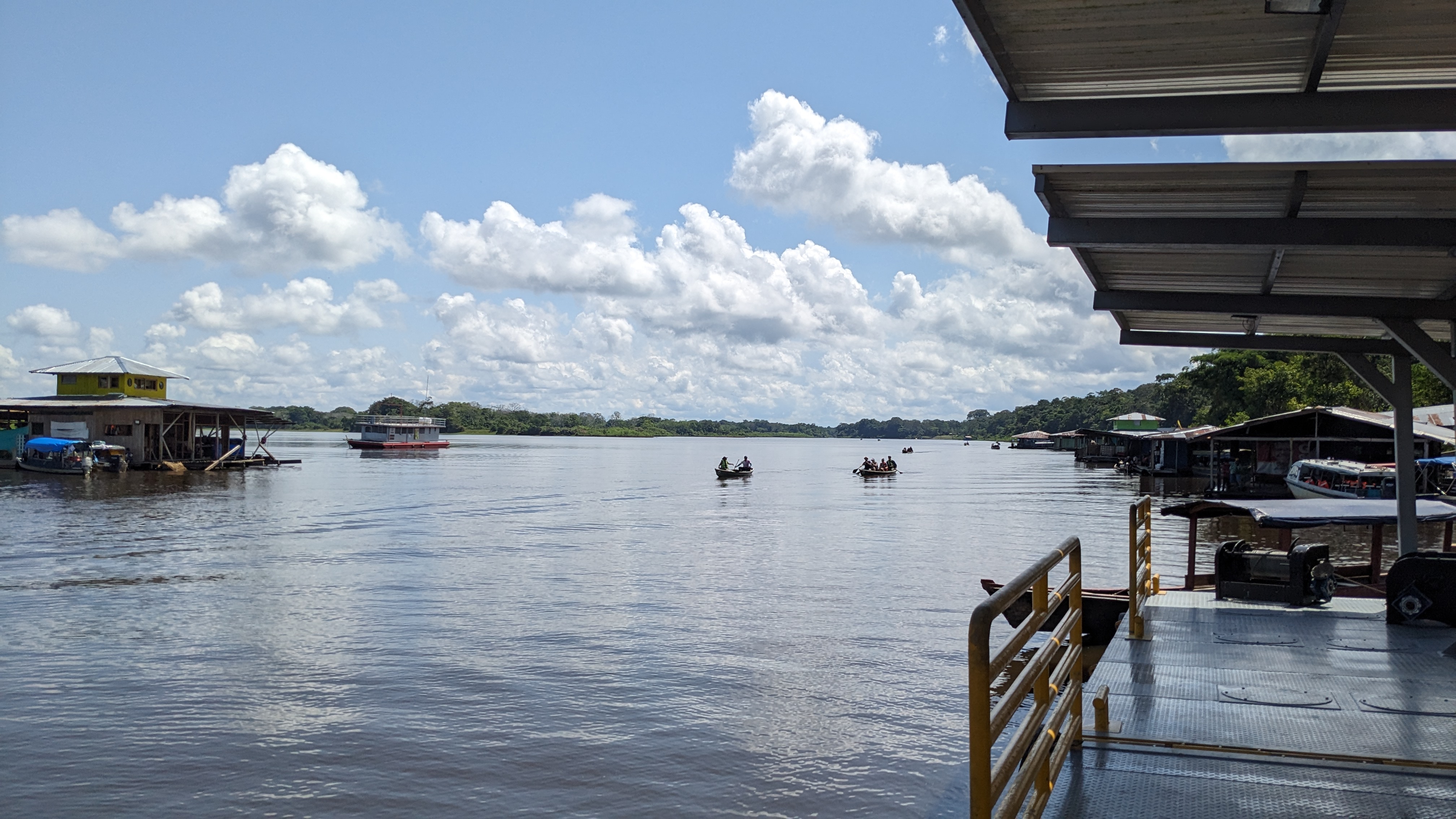

The passenger dock for Puerto Narino. As the water rises during the rainy season the floating dock moves up the stairs and will be close to the level of the dock in the sky.
Going down the creek we saw docks full of small power boats, canoes and many buildings sitting on pontoons so they could rise and fall with the river. All along the creek houses and walkways were built on stilts for the rainy season.


Going up the river was fascinating. The water was muddy and full of hyacinths and lily pads growing autonomously. There was also lots of debris floating down. In spots the river was wide and in other spots the islands made it narrow. We passed lots of traffic on the river that ranged from large commercial craft to small home built ones. A common site was a canoe type boat of varying size with what looked like a lawnmower engine with a long shaft and a prop. They were everywhere.


Our first stop going up the river was at Monkey Island. Walking down a jungle trail it didn't take long before the monkeys were all over us. As far as I could tell nobody was feeding them and they were just curious about us and wanted to play. The island had typical jungle foliage that was lush despite the obvious signs it was the dry season. The monkeys were fun.

Our second stop was at a Ticuna village in the territory of Macedonia. The Ticuna are one of the several indigenous tribes that live in the Colombian Amazon. We went into one of their large houses where they had craft tables set up for sale and performed the Pelazon ceremony which is the coming of age ceremony for a woman. A local Shaman narrated the event. Our guide told us they had the best crafts so we indulged and bought gifts there.


A Pink Lotus flower
After our brief stay we motored on to Puerto Narino. At several points along the way we saw Amazon gray and pink dolphins. We even saw some of the gray dolphins jump. The Amazon dolphins are smaller than their offshore cousins and the pink look totally different.


Late afternoon
We arrived at Puerto Narino on a nice new dock structure that we had to climb up because of the low water. The entrance fee was waived for us being senior citizens. We proceeded on to our lunch.


There was a large, very nice restaurant that was busy with many people having lunch. It was a cafeteria-style lunch with as much as you wanted to eat with several fish dishes, multiple kinds of rice and some other delicacies. After eating more than we should our guide told us about an observation tower and helado stand to visit. After visiting them we were running short on time and just visited a chocolate factory to buy some samples and headed back to the boat.
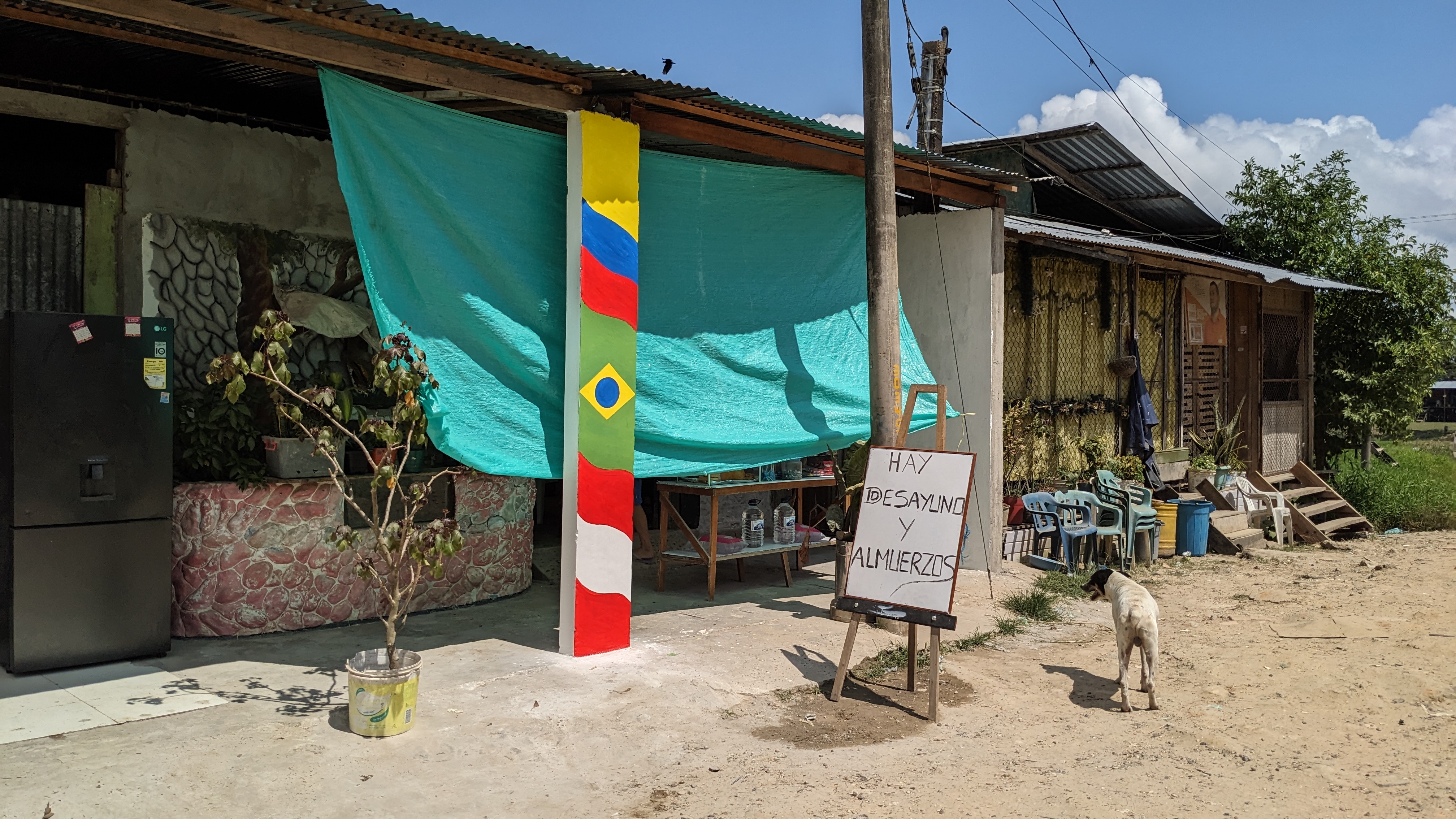


A levee to keep water out of this area
When we arrived on the dock we found we were the first ones back. When our guide arrived he told us that in Colombia they always tell you a time earlier than they want because everyone will show up late. We didn't get the memo and thought the time was the time. At lunch we met a man from Bogota who was traveling with his son and they spoke English so we had a pleasant conversation.


More elevated homes and the walkway between the rows of houses.
On the way back down the river we spent more time dolphin watching that caused us to miss a stop in Peru so we went straight to the Lotus Flower Nature Preserve as our last stop. The grounds were beautiful with some resident Macaws, lotus flowers and Amazon catfish. But, with the sun setting we headed back to Letitia and the end of a long day.


Hunting spears
Our second day we got up later after getting up early the previous two days and spent the time leisurely walking around the town. We went through the public market and the Ethnographic Museum and ended up in the pool enjoying the remainder of the day.


This chart shows the rainfall in the Amazon region. The interesting point is that one line represents rain in the northern hemisphere and the other in the southern hemisphere. When one is low, the other is high.
That night Colombia played in a semi-final round of the All-Americas Cup and won to move on to the Championship. The win was followed by fireworks, horn blaring and lots of party music. Always a party in Colombia.

The next day, we got up late, had breakfast, checked out and flew back to Cartagena. Our adventure was over.

It was a good trip that left us interested to go back again. All the flights were on-time, comfortable and we had no issues getting through the terminals. The Amazon is a sight to behold.

The Amazon


