Our recent offshore passage from Beaufort to St Augustine was uneventful but the dearth of wind made it long and unexciting. The lack of wind was mostly the result of timing due to weather. When we plan our voyages we normally look at the conditions where we are going. Those conditions are more important than those along the way because our boat is equipped to be reasonably comfortable in many unpleasant conditions of travel. But, conditions on arrival could be lethal. Linn and Larry Pardey say that land is the enemy of boats and it is true. Most bad things happen to boats when they come in contact with some point of land.
We have been reevaluating our travel strategies to ultimately sail more, anchor more and enjoy the journey rather than be rushed into passages that result in less enjoyable travel. In this passage we had several destination constraints to consider. The first was that a major cold front was to pass through the northern Florida region Saturday evening which meant we needed to be berthed before it hit. Secondly, the St Augustine channel is considered a fair weather channel although it is deep and wide it can be treacherous. We've come in it twice before at night but if we had our preference we would come in during daylight on an incoming tide with the wind behind us. Friday afternoon before 1620 was when all those conditions would be present. Saturday was possible but with the unknown arrival of the cold front it would be a gamble. As it turned out it came through much later than anticipated and was not an issue here in St Augustine. A bailout option could have been either the St John's or St Mary's river inlets but as it turned out they got hammered. Once again our "safe" decision to come when we did and planning to arrive when we did made our trip safe but denied us the opportunity to sail.
In the passage from Beaufort there are 5 class "A" or commercial inlets (Cape Fear River, Charleston, Savannah River, St Mary's River and St John's River) that could be used to breakup the passage or provide safe harbor but in bad weather it may not be safe even to enter them. There are a few other inlets that would be even less safe to enter in an emergency.
So when planning for long-distance passage it's rarely a question of when you want to leave but when do you want to arrive.
Upon arrival our plan was to get a slip for 2 nights and then go to a mooring for the remainder of the time. Since Sunday was forecasted to be stormy we opted for a third night in the slip before going to the mooring field. With the wind and significant current getting in and out of a slip can be challenging if not damaging. As it turned out Sunday was not bad but we used the time to accomplish other tasks. Our purpose for going in a slip was to provide an opportunity to complete routine maintenance and fix items that developed during the passage. Upon arrival we needed an engine oil change, change engine fuel filters, wash the boat, add water, flush lines, remove refuse and fortunately this time there was nothing to repair.
During the passage we were able to split the watches and each get a fair amount of rest so even though we were tired upon arrival we were not beyond a good night's sleep. The first night of arrival we walked across the street for dinner on the patio of a very nice local eatery, took a short stroll and then went to bed.
Tasks for this week have been pretty well programmed although we do have some time planned to meet up with some other cruisers we met in Cape May. Our current task list will take us through to the middle of next week as we get ready to move on down the coast and beyond after Thanksgiving. After that we can begin to relax and really enjoy our town and spend more time with family nearby.
Wednesday, November 18, 2015

Sunday, November 8, 2015
Back to the sun
We left the marina at Cherry Point MCAS before daylight at 0530 on Wednesday 4 November to go offshore directly to St Augustine. We had received our weather routing information from our weather routers, Dane and Jennifer Clark, the night before with way points that would keep us in the Labrador current and out of the Gulf Stream. Although we had to motor we made it to St Augustine in time for the Bridge of Lions opening at 1330 on Friday 6 November after traveling about over 400 nm.
We left Cherry Point's Hancock Creek in the dark with a light mist. The challenge was getting out through the narrow channel with unlit marks through shallow water to the Neuse River which we did securing our lines and fenders before heading toward Adams Creek and the ICW. Nautical twilight began as we were heading down the river.

Dolphins in Adams Creek.

Departing Beaufort Inlet.
Scheduling our trip required lots of considerations. Last year we made the trip from Beaufort to St Augustine to in about 57 hours. This time we were leaving from Cherry Point which is about 30 miles above Beaufort. Additionally we needed to stop for fuel. Jarrett Bay Marina had an excellent fuel price and was right on the waterway and they opened at 0800. We fueled up and got out of the marina in heavy current and then out the channel into the ocean before 1000 heading southwest. We always look at the arrival conditions and when we need to get in based on tide, wind, weather, visibility. Our optimal time to arrive was Friday afternoon within an hour of high tide.

When we got offshore wind was blowing nicely but directly astern. Wind gauge showed the wind between 175-180 degrees the entire time. We could have flown the spinnaker but with the chances of rain high I didn't want to have to put it away wet so we motored instead. We followed our waypoints and were able to make excellent time. A couple of times we considered sailing but the apparent wind was never very strong and with the weather front coming through on Saturday we needed to keep up speed.

During the trip we had numerous visitors. We saw more dolphins on this passage than I think we've ever seen. Starting on Adams Creek just off the Neuse River and then every few hours offshore, even at night and also in the channel coming into St Augustine. At one point we counted 12 dolphins playing in the bow wave. Sighting dolphins has always been considered a good luck symbol and we counted on that to follow through for us. As our passage was uneventful their luck held out. The repairs and maintenance we did have begun to pay off in improved performance and reliability over the condition of the boat when we bought it.
We also had some unusual visitors. Off the coast of North Carolina we had a monarch butterfly land on the lines for the dinghy and ride for a few hours. We also had a small wren riding on the boat for a while.

Sunset on Thursday. Wednesday was overcast.
Also during the passage we saw several Navy ships conducting firing exercises and had one sub cross behind us on its way into port.
Our passage consisted of 4 way points. The first just north of Frying Pan shoals about 70 nautical miles SSW of Beaufort. Rather than making the slight turn to the SW we continued 20 nm to get across the shoals so we would stay in deeper water and there are marks and obstructions in closer that we needed to avoid in the dark. The next point was about 70 nm about 20 nm off Myrtle Beach. The next point was 90 nm just off Beaufort, SC and then to a point 85 nm south about 30 nm off Cumberland Island, GA and then to St Augustine. We were able to keep up an average of just under 8 kts. Once we made our final turn we slowed down to ensure we didn't arrive too early. The trip from Beaufort NC to St Augustine we made in about 50 hrs.

Avenida Menendez in front of the St Augustine Municipal Marina.
After refueling we got into our slip for a weekend of maintenance after the 900 mile trip from Oxford, MD which we left 12 days earlier with spending a week at Cherry Point and an extra day at Dowry Creek. Now for a few weeks in St Augustine to enjoy the sun and warmer weather.
We left Cherry Point's Hancock Creek in the dark with a light mist. The challenge was getting out through the narrow channel with unlit marks through shallow water to the Neuse River which we did securing our lines and fenders before heading toward Adams Creek and the ICW. Nautical twilight began as we were heading down the river.
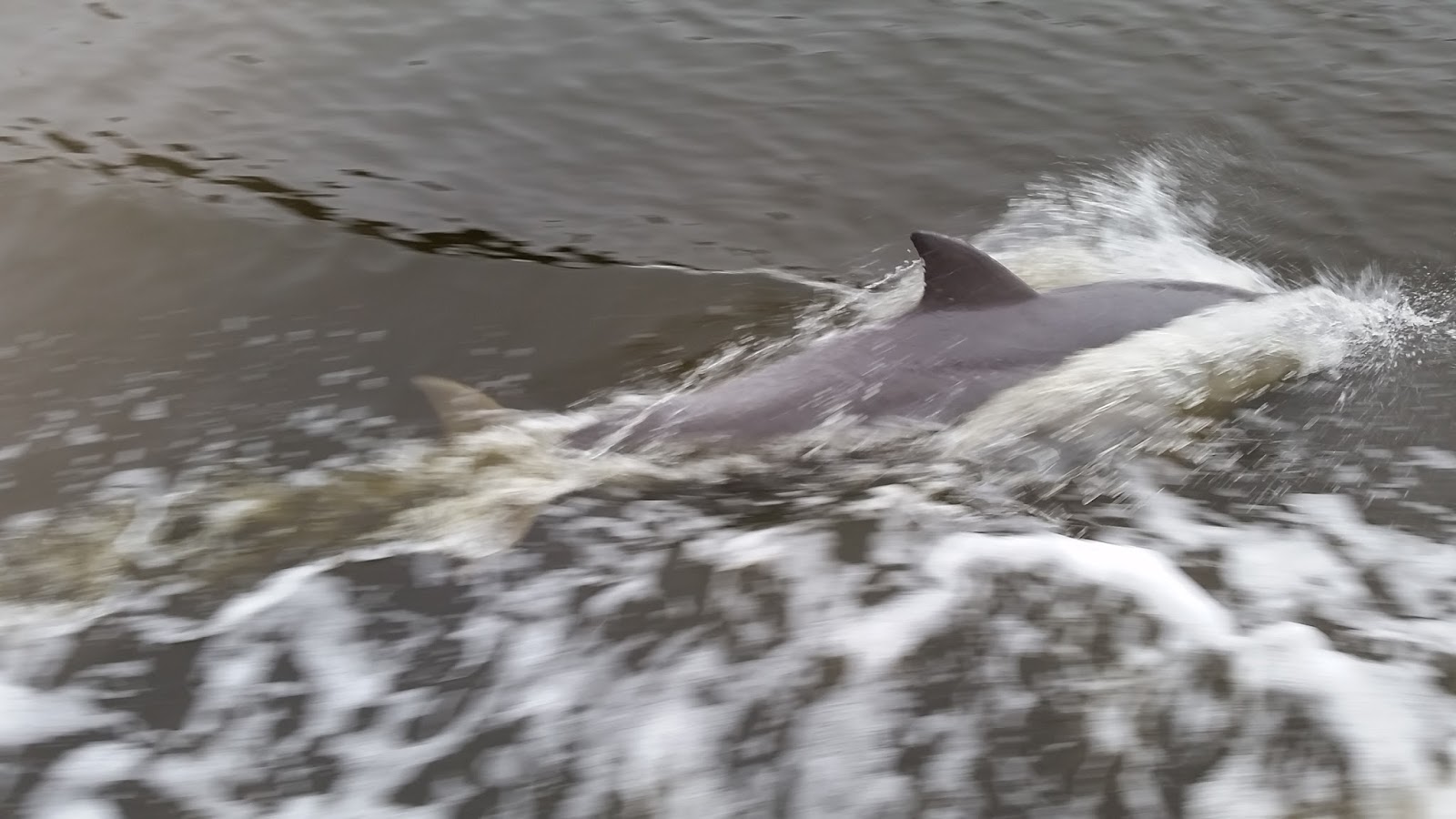
Dolphins in Adams Creek.

Departing Beaufort Inlet.
Scheduling our trip required lots of considerations. Last year we made the trip from Beaufort to St Augustine to in about 57 hours. This time we were leaving from Cherry Point which is about 30 miles above Beaufort. Additionally we needed to stop for fuel. Jarrett Bay Marina had an excellent fuel price and was right on the waterway and they opened at 0800. We fueled up and got out of the marina in heavy current and then out the channel into the ocean before 1000 heading southwest. We always look at the arrival conditions and when we need to get in based on tide, wind, weather, visibility. Our optimal time to arrive was Friday afternoon within an hour of high tide.

When we got offshore wind was blowing nicely but directly astern. Wind gauge showed the wind between 175-180 degrees the entire time. We could have flown the spinnaker but with the chances of rain high I didn't want to have to put it away wet so we motored instead. We followed our waypoints and were able to make excellent time. A couple of times we considered sailing but the apparent wind was never very strong and with the weather front coming through on Saturday we needed to keep up speed.

During the trip we had numerous visitors. We saw more dolphins on this passage than I think we've ever seen. Starting on Adams Creek just off the Neuse River and then every few hours offshore, even at night and also in the channel coming into St Augustine. At one point we counted 12 dolphins playing in the bow wave. Sighting dolphins has always been considered a good luck symbol and we counted on that to follow through for us. As our passage was uneventful their luck held out. The repairs and maintenance we did have begun to pay off in improved performance and reliability over the condition of the boat when we bought it.
We also had some unusual visitors. Off the coast of North Carolina we had a monarch butterfly land on the lines for the dinghy and ride for a few hours. We also had a small wren riding on the boat for a while.

Sunset on Thursday. Wednesday was overcast.
Also during the passage we saw several Navy ships conducting firing exercises and had one sub cross behind us on its way into port.
Our passage consisted of 4 way points. The first just north of Frying Pan shoals about 70 nautical miles SSW of Beaufort. Rather than making the slight turn to the SW we continued 20 nm to get across the shoals so we would stay in deeper water and there are marks and obstructions in closer that we needed to avoid in the dark. The next point was about 70 nm about 20 nm off Myrtle Beach. The next point was 90 nm just off Beaufort, SC and then to a point 85 nm south about 30 nm off Cumberland Island, GA and then to St Augustine. We were able to keep up an average of just under 8 kts. Once we made our final turn we slowed down to ensure we didn't arrive too early. The trip from Beaufort NC to St Augustine we made in about 50 hrs.

Avenida Menendez in front of the St Augustine Municipal Marina.
After refueling we got into our slip for a weekend of maintenance after the 900 mile trip from Oxford, MD which we left 12 days earlier with spending a week at Cherry Point and an extra day at Dowry Creek. Now for a few weeks in St Augustine to enjoy the sun and warmer weather.
Saturday, October 31, 2015
Friday, October 30, 2015
Welcome to our home
We've been writing about our home for over a year but most of the discussion has been about places we've been and things we've done. Several folks have asked questions about our boat that we call home so this post discusses our home and goes in to some detail about the improvements and modifications we've done to make the boat suitable for long-term cruising and living.
Our boat is a 2003 Island Packet (IP) 420. The boat is about 45' overall and 14'4" wide. Although it has significant girth, the narrow stern makes it more comfortable in a seaway. One of the incredible features about IP's is that essentially everything inside the boat is living or storage area. As a 45' boat it has as much space inside as a small apartment and surprisingly enough storage to subsist for months without the need to go ashore and the improvements we've made complement those features and add to our capability to be self-sufficient.

Our boat has 3 cabins, 2 heads and a galley. We have the main cabin shown below, the aft cabin shown above and the master suite also shown below. In nautical terminology heads refer to bathrooms. There is 1 in the master suite and 1 off the main cabin and aft cabin. In our aft cabin we have a printer/scanner/copier for personal needs.

The aft head.


The main galley.

Master cabin including the master head in the background. The shower is behind the bulkhead and to the right of the area you see. Forward of the head is another storage area and the anchor locker where we have 300' of chain and 200' of rope rode for our primary anchor and 30' of chain and 250' of rope rode our secondary anchor. We also have a 3rd anchor in one of our cockpit lazarettes with 200' of rope rode.

Looking at our power plants we have a primary means of propulsion as our sails and an auxiliary power plant of a Yanmar 75 hp turbo diesel located behind the galley and under the cockpit.


We have several sources of alternative power for the boat. We have 470 watts of solar power capability and a wind generator that should both be capable of providing enough power through our DC battery bank of 600 amps to run everything on our boat. To supplement the battery charging and provide direct AC power primarily for our HVAC system we have a Northern Lights 3 cylinder 5 kw diesel generator.

Some of the key improvements we made were to add and arch on the stern to support the wind and power installation. We also added the diesel generator. Because the previous owner had few electronics we added a complete suite of navigational electronics including wind, solar, depth, chart plotter and auto-helm. Because of the sailing weight of the outfitted boat we raised the waterline so that the bottom protection would end above where the water actually did to reduce the possibility of damage to the fiberglass. Also to protect the bottom we installed an epoxy barrier coat last year wen we got the boat. We made numerous other enhancements and of course lots of repairs to improve the livability and comfort of the boat. We also added a WIFI booster to facilitate connection and we are looking at satellite options to provide complete access to the internet anywhere in the world. We also affixed an EPIRB and AIS for identification and rescue if necessary.
We have mentioned other features in posts and will be talking about others in future posts.
Our boat is a 2003 Island Packet (IP) 420. The boat is about 45' overall and 14'4" wide. Although it has significant girth, the narrow stern makes it more comfortable in a seaway. One of the incredible features about IP's is that essentially everything inside the boat is living or storage area. As a 45' boat it has as much space inside as a small apartment and surprisingly enough storage to subsist for months without the need to go ashore and the improvements we've made complement those features and add to our capability to be self-sufficient.

Our boat has 3 cabins, 2 heads and a galley. We have the main cabin shown below, the aft cabin shown above and the master suite also shown below. In nautical terminology heads refer to bathrooms. There is 1 in the master suite and 1 off the main cabin and aft cabin. In our aft cabin we have a printer/scanner/copier for personal needs.

The aft head.


The main galley.

Master cabin including the master head in the background. The shower is behind the bulkhead and to the right of the area you see. Forward of the head is another storage area and the anchor locker where we have 300' of chain and 200' of rope rode for our primary anchor and 30' of chain and 250' of rope rode our secondary anchor. We also have a 3rd anchor in one of our cockpit lazarettes with 200' of rope rode.

Looking at our power plants we have a primary means of propulsion as our sails and an auxiliary power plant of a Yanmar 75 hp turbo diesel located behind the galley and under the cockpit.


We have several sources of alternative power for the boat. We have 470 watts of solar power capability and a wind generator that should both be capable of providing enough power through our DC battery bank of 600 amps to run everything on our boat. To supplement the battery charging and provide direct AC power primarily for our HVAC system we have a Northern Lights 3 cylinder 5 kw diesel generator.

Some of the key improvements we made were to add and arch on the stern to support the wind and power installation. We also added the diesel generator. Because the previous owner had few electronics we added a complete suite of navigational electronics including wind, solar, depth, chart plotter and auto-helm. Because of the sailing weight of the outfitted boat we raised the waterline so that the bottom protection would end above where the water actually did to reduce the possibility of damage to the fiberglass. Also to protect the bottom we installed an epoxy barrier coat last year wen we got the boat. We made numerous other enhancements and of course lots of repairs to improve the livability and comfort of the boat. We also added a WIFI booster to facilitate connection and we are looking at satellite options to provide complete access to the internet anywhere in the world. We also affixed an EPIRB and AIS for identification and rescue if necessary.
We have mentioned other features in posts and will be talking about others in future posts.
Wednesday, October 28, 2015
Gone
After a month to the day we left Oxford Boatyard after many updates, repairs and maintenance. We also spent almost 2 weeks during that month visiting friends and family. Watched the Chicago Cubs make it to playoff for the National League Championship. As a finale to our stay we were able to meet up with many of our sailing friends at an HHSA Club rendezvous in Cambridge, MD over the weekend hosted by friends Tom and Judy Lampley.


We left Cambridge about 1230 Sunday the 25th. Originally we had planned to stop going down the Bay but changed our minds due to coming weather and the length of time it would add to the passage so we did an overnight down the Bay. Forecast was for wind to come up early in the afternoon out of the north that we could sail. As it was the wind didn't come up until the evening. We motored for 9 hrs until the wind came up and it quickly got into the 20-30 range so we sailed on only our jib and ran consistently in the 8-10 kt range. The swells also built as we got down the Bay and when going into Norfolk were probably in the 5-6' range. We took short shifts all night napping briefly from time to time. We tied up at a dock in Portsmouth on the ICW at 0600 to for about 2 hours so we could both nap and check things around the boat before we went on.
Our trip through the bridges and locks in Norfolk was smooth and fast. We actually cleared the last bridge just after noon and motored the remaining 30 miles to Coinjock, NC where we tied up at the marina to spend the night. Tuesday morning we left later than we planned because we overslept by an hour from being so tired the night before. But we got off at sunrise albeit later than planned for our 80 mile trip to Dowry Creek in Belhaven, NC. We got in about 1730 just as the rain started.


With the weather that was threatening we decided that we would hole up at Dowry Creek instead of anchoring out and continuing on. That would also give us a chance to relax and rewind after the days of work getting the boat ready and then several long days of traveling. The marina is popular with cruisers because it is an easy in and out for the ICW and the staff is very friendly and the rates are great. There's virtually no cell phone service here but there is a working wifi and all the networks come in on TV. Tomorrow we'll push on to Cherry Point.
The weather here in NC is warmer than what we left in the Bay and after our stay we'll be on to Florida to avoid the cold.
Will do another blog article with details about the boat and work we accomplished including interior photos of the boat.


We left Cambridge about 1230 Sunday the 25th. Originally we had planned to stop going down the Bay but changed our minds due to coming weather and the length of time it would add to the passage so we did an overnight down the Bay. Forecast was for wind to come up early in the afternoon out of the north that we could sail. As it was the wind didn't come up until the evening. We motored for 9 hrs until the wind came up and it quickly got into the 20-30 range so we sailed on only our jib and ran consistently in the 8-10 kt range. The swells also built as we got down the Bay and when going into Norfolk were probably in the 5-6' range. We took short shifts all night napping briefly from time to time. We tied up at a dock in Portsmouth on the ICW at 0600 to for about 2 hours so we could both nap and check things around the boat before we went on.
Our trip through the bridges and locks in Norfolk was smooth and fast. We actually cleared the last bridge just after noon and motored the remaining 30 miles to Coinjock, NC where we tied up at the marina to spend the night. Tuesday morning we left later than we planned because we overslept by an hour from being so tired the night before. But we got off at sunrise albeit later than planned for our 80 mile trip to Dowry Creek in Belhaven, NC. We got in about 1730 just as the rain started.


With the weather that was threatening we decided that we would hole up at Dowry Creek instead of anchoring out and continuing on. That would also give us a chance to relax and rewind after the days of work getting the boat ready and then several long days of traveling. The marina is popular with cruisers because it is an easy in and out for the ICW and the staff is very friendly and the rates are great. There's virtually no cell phone service here but there is a working wifi and all the networks come in on TV. Tomorrow we'll push on to Cherry Point.
The weather here in NC is warmer than what we left in the Bay and after our stay we'll be on to Florida to avoid the cold.
Will do another blog article with details about the boat and work we accomplished including interior photos of the boat.
Friday, October 23, 2015
Ready to go
After a month in Oxford we are finally ready to move on. Our immediate plans are to leave Saturday and go further up the Choptank River to Cambridge, MD to meet with friends from our sailing club and then Sunday head south down the Bay. We had planned to stop going down the Bay but we now plan to go straight through and out next stop will be Coinjock, NC on Monday.
One of the exciting things about living on a boat is there are always things to do. We came into the Boatyard with a few relatively minor tasks to do but are leaving with several significant improvements.
The largest item is that we raised the waterline meaning that the bottom paint now comes further up the hull to protect more of the hull from sea growth. The normal waterline established by the manufacturer is based on their calculation from the design plans but reality of adding cruising equipment and provisions puts the boat lower in the water so to protect the hull we raised the level of bottom paint. With everything on board it appears we still have bottom paint above the waterline.
The next major item we did was replace the onboard AC battery charger. The OEM charger was only rated at 40 amps and as we found it after we replaced it it was nearly burned out. We replaced it with a 100 amp charger that significantly increases the power going into the battery when connected to shore power or charging from the generator. We found when we were up north that our wind and solar failed to charge the batteries and required running the generator for hours to get sufficient charge to the batteries. As we get back south we should improve the reliability of our wind and solar but when that doesn't work we should get better charging from the generator. As part of the installation we had to use larger cables to carry the higher load to the batteries.
We also took the opportunity to replace a number of the original hoses including the engine exhaust hose, the engine vented loop hoses, the refrigerator drain hose, the scupper hoses and the cockpit cold locker hose.
While we were here I found the U brace on the underdeck toggle was broken. While replacing it I suggested that we remove the deck bracket and rebed it. After we took the bracket off we found that the brace had rusted out from water leaking through the bracket because the holes were drilled larger than the bolts for the bracket. So we filled the holes with epoxy, redrilled them and rebedded the bracket. As a result we had to retune the rigging. I'm not sure we have it right but we'll see how it does and maybe we need to retune it later.
We also did a number of maintenance items and gelcoat repairs. We also used the time to reprovision with nonperishable items for a long cruise. With all the work completed and everything stowed we're ready to head out. But with all the stuff we've added we still have room for more stuff. There are probably some more tools and equipment we need that we will add over the next year to decrease our need for technical support.
Hard to believe we've been here for a month but lots has happened including a lot of travel, the boat show, a hurricane and reuniting with lots of friends. So now we're ready to go with lots to look forward to in our travels.
One of the exciting things about living on a boat is there are always things to do. We came into the Boatyard with a few relatively minor tasks to do but are leaving with several significant improvements.
The largest item is that we raised the waterline meaning that the bottom paint now comes further up the hull to protect more of the hull from sea growth. The normal waterline established by the manufacturer is based on their calculation from the design plans but reality of adding cruising equipment and provisions puts the boat lower in the water so to protect the hull we raised the level of bottom paint. With everything on board it appears we still have bottom paint above the waterline.
The next major item we did was replace the onboard AC battery charger. The OEM charger was only rated at 40 amps and as we found it after we replaced it it was nearly burned out. We replaced it with a 100 amp charger that significantly increases the power going into the battery when connected to shore power or charging from the generator. We found when we were up north that our wind and solar failed to charge the batteries and required running the generator for hours to get sufficient charge to the batteries. As we get back south we should improve the reliability of our wind and solar but when that doesn't work we should get better charging from the generator. As part of the installation we had to use larger cables to carry the higher load to the batteries.
We also took the opportunity to replace a number of the original hoses including the engine exhaust hose, the engine vented loop hoses, the refrigerator drain hose, the scupper hoses and the cockpit cold locker hose.
While we were here I found the U brace on the underdeck toggle was broken. While replacing it I suggested that we remove the deck bracket and rebed it. After we took the bracket off we found that the brace had rusted out from water leaking through the bracket because the holes were drilled larger than the bolts for the bracket. So we filled the holes with epoxy, redrilled them and rebedded the bracket. As a result we had to retune the rigging. I'm not sure we have it right but we'll see how it does and maybe we need to retune it later.
We also did a number of maintenance items and gelcoat repairs. We also used the time to reprovision with nonperishable items for a long cruise. With all the work completed and everything stowed we're ready to head out. But with all the stuff we've added we still have room for more stuff. There are probably some more tools and equipment we need that we will add over the next year to decrease our need for technical support.
Hard to believe we've been here for a month but lots has happened including a lot of travel, the boat show, a hurricane and reuniting with lots of friends. So now we're ready to go with lots to look forward to in our travels.
Friday, October 9, 2015
Getting ready for our next adventures
We spent almost 2 weeks visiting with friends and family in Illinois, Pennsylvania and back in the Bay area. Now we are busy getting boat chores done to get ready to head south.
Our project list got delayed due to preparations for the possible visit of Hurricane Joaquin. Fortunately the storm turned but our boat had been prepared for the worst by the boatyard crew.Upon our return we needed to get on top of our project list and get ready for our next adventures.
Many of our boat chores involved fixing things that broke or were not quite correctly installed. We made some significant additions to what we've already done. This post is about the work we're achieving in our work to get the boat ready for new adventures.
The largest chore we're doing is to raise the waterline of the boat. This is not about making the boat ride higher in the water it involves moving the waterline further up the hull. With all the gear, equipment and provisions we've added the boat is sitting lower in the water so the barnacles and slime grow further up the hull. By raising the waterline we get the bottom paint higher up the hull to defeat the contaminant growth on the gelcoat. In addition to the growth slowing down our speed and increasing fuel use, barnacles growing on the hull will eat into the gelcoat and damage the fiberglass. This is a long-term improvement. We discussed doing it last year when we were doing the major outfitting but decided to wait and see how everything worked.
The next major addition that we're doing is to replace the OEM battery charger with one that is much larger. Our OEM charger only providers 40 amps of output and our new one outputs 100 amps. We needed to do this so when we have cloudy windless days and need to run our generator we can charge our batteries faster with less fuel consumption. Also, at a dck when connected to shore power we can completely recharge our batteries in a day where our old charger might not due that.
Other major improvements include replacing the exhaust and engine exhaust water hoses; connecting our FM radio to our TV antenna; gelcoat repairs for the remaining issues from our accident back in July; and some other minor fixes. Earlier this week when I was crawling around in the anchor locker I found that the horseshoe bracket holding the chain plate for our staysail had broken. We will be replacing it and then checking the rig tuning once we're back in the water.
I have quite a list of work to do over this weekend as we hurry to get the boat back in the water. We also want to take this opportunity to refine our inventory of spares and maintenance supplies so that as we go offshore for longer periods we can be self-sufficient. We also continue to learn more about the boat and how to fix stuff which will enable us to continue traveling with improvised solutions to challenges we may face.
So as we work through past issues we focus on our next adventures and work to ensure success. In a few months we hope to be spending relaxed times in the sun wit all the work behind us although we will always have maintenance to do.
Our project list got delayed due to preparations for the possible visit of Hurricane Joaquin. Fortunately the storm turned but our boat had been prepared for the worst by the boatyard crew.Upon our return we needed to get on top of our project list and get ready for our next adventures.
Many of our boat chores involved fixing things that broke or were not quite correctly installed. We made some significant additions to what we've already done. This post is about the work we're achieving in our work to get the boat ready for new adventures.
The largest chore we're doing is to raise the waterline of the boat. This is not about making the boat ride higher in the water it involves moving the waterline further up the hull. With all the gear, equipment and provisions we've added the boat is sitting lower in the water so the barnacles and slime grow further up the hull. By raising the waterline we get the bottom paint higher up the hull to defeat the contaminant growth on the gelcoat. In addition to the growth slowing down our speed and increasing fuel use, barnacles growing on the hull will eat into the gelcoat and damage the fiberglass. This is a long-term improvement. We discussed doing it last year when we were doing the major outfitting but decided to wait and see how everything worked.
The next major addition that we're doing is to replace the OEM battery charger with one that is much larger. Our OEM charger only providers 40 amps of output and our new one outputs 100 amps. We needed to do this so when we have cloudy windless days and need to run our generator we can charge our batteries faster with less fuel consumption. Also, at a dck when connected to shore power we can completely recharge our batteries in a day where our old charger might not due that.
Other major improvements include replacing the exhaust and engine exhaust water hoses; connecting our FM radio to our TV antenna; gelcoat repairs for the remaining issues from our accident back in July; and some other minor fixes. Earlier this week when I was crawling around in the anchor locker I found that the horseshoe bracket holding the chain plate for our staysail had broken. We will be replacing it and then checking the rig tuning once we're back in the water.
I have quite a list of work to do over this weekend as we hurry to get the boat back in the water. We also want to take this opportunity to refine our inventory of spares and maintenance supplies so that as we go offshore for longer periods we can be self-sufficient. We also continue to learn more about the boat and how to fix stuff which will enable us to continue traveling with improvised solutions to challenges we may face.
So as we work through past issues we focus on our next adventures and work to ensure success. In a few months we hope to be spending relaxed times in the sun wit all the work behind us although we will always have maintenance to do.
Subscribe to:
Posts (Atom)